DDR5 6000 vs DDR5 7200: Is Faster RAM Worth It for Gaming?
Don't waste money on overhyped RAM! Find out if DDR5-7200 actually beats DDR5-6000 in real-world gaming performance. Click to see the benchmark truths.
Enjoying this? Sign up to earn credits just for reading. Create free account
DDR5-6000 vs DDR5-7200: A Practical Gaming Guide
A balanced summary for PC builders and gamers, with a focus on real-world value and common platform behavior.
Note: Memory performance varies by CPU, motherboard, BIOS, and the specific memory ICs in the kit. The guidance below reflects widely reported hardware testing and mainstream platform recommendations rather than a single universal rule.
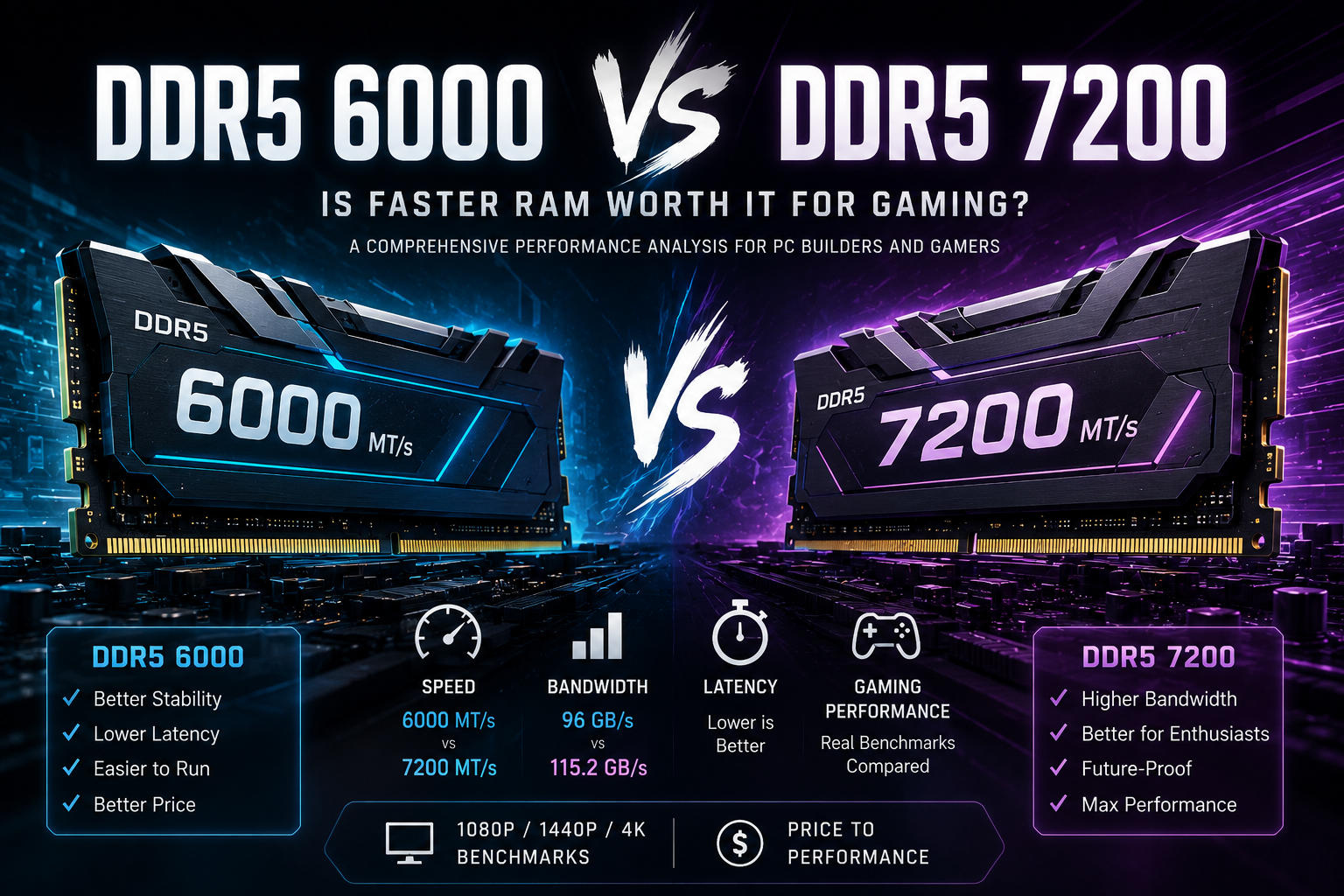
Core Differences at a Glance
| Specification | DDR5-6000 | DDR5-7200 |
|---|---|---|
| Transfer rate | 6000 MT/s | 7200 MT/s |
| Dual-channel bandwidth | ~96 GB/s | ~115.2 GB/s |
| Theoretical bandwidth increase | — | ~20% |
| Typical CL range | CL30–CL36 | CL34–CL40 |
| Typical absolute latency | ~9.3–10.0 ns | ~9.4–10.0 ns |
| Intel XMP 3.0 | Yes | Yes |
| AMD EXPO | Yes, on many kits | Yes, on some kits |
| Platform tuning difficulty | Moderate | Higher |
| Typical price (2×16 GB) | About $80–$130 | About $130–$220 |
| Common ICs | Samsung B-die, Hynix M/A-die | Samsung B-die, Micron |
A good DDR5-6000 kit with strong ICs and tight timings can often match or beat a less-well-binned DDR5-7200 kit in real-world gaming.
Bandwidth Formula
Bandwidth (GB/s) = (Transfers per second × Bus width in bits) / 8

DDR5-6000 dual channel: 6000 × 128 / 8 = 96 GB/s
DDR5-7200 dual channel: 7200 × 128 / 8 = 115.2 GB/s
Theoretical bandwidth is useful, but gaming performance depends heavily on whether the CPU and game workload can actually use that extra headroom.
How RAM Speed Affects Gaming
RAM speed matters most when the CPU is part of the bottleneck. In many modern games, especially at 1440p or 4K, the GPU is the limiting factor, so faster memory provides little or no visible gain.
Memory speed is more likely to matter in:
- High refresh-rate gaming, such as 144 Hz, 240 Hz, or 360 Hz
- 1080p setups with a strong GPU
- CPU-sensitive titles, including some open-world games, simulations, and strategy titles
It tends to matter less in:
- 4K gaming
- Games that fit comfortably in cache
- Titles that are heavily GPU-limited
Platform Notes: Intel vs AMD
Intel platforms
Intel systems often show a little more benefit from higher memory speeds than AMD systems, especially when the platform is tuned well and the memory controller is strong. That said, the gains are still usually modest unless the build is very tuned or the workload is memory-sensitive.
AMD AM5 platforms
For Ryzen 7000 and 9000 series, DDR5-6000 is commonly viewed as a strong sweet spot. Higher speeds can work, but they often require more tuning and may not deliver enough extra performance to justify the extra cost for gaming.
In practical terms, DDR5-6000 is the safer and more value-focused recommendation for most AM5 gaming builds.
What to Expect in Games
Average FPS
For many games, the difference between DDR5-6000 and DDR5-7200 is small enough that it can fall within normal benchmarking variance.
1% lows and smoother gameplay
Some titles, especially those that are CPU-sensitive or run at very high refresh rates, may show a noticeable improvement in 1% lows with faster memory. The uplift is usually real, but not dramatic in most gaming scenarios.
Games that may benefit more:
- Open-world titles
- Strategy and simulation games
- Some competitive shooters at very high refresh rates
Games that may show little difference:
- Linear action games
- Console-first optimized titles
- Scenarios that are already GPU-bound
Latency and Timings Matter
The raw speed number is only part of the story. Timings, memory controller quality, and BIOS tuning can matter just as much.
A simple way to think about it:
- DDR5-6000 CL30 is often a very strong value choice.
- DDR5-7200 CL34 or tighter can be appealing for enthusiasts, but the gain is not guaranteed.
- A well-tuned DDR5-6000 kit can sometimes outperform a stock DDR5-7200 kit in real-world use.
That is why the best memory kit is not always the one with the highest advertised speed.
Beyond Gaming
If you also do content creation, heavy compilation, video editing, or other memory-intensive work, DDR5-7200 may be more justified. In those cases, the extra bandwidth can be more useful than it is in a pure gaming build.
Common examples where faster memory can help more:
- Video editing and rendering
- Large project compilation
- CPU-based AI inference
- Streaming while gaming
Price-to-Performance
Typical pricing (2×16 GB)
| Tier | Speed | Typical timing range | Approx. price |
|---|---|---|---|
| Budget | DDR5-5600 | CL36 | $55–$80 |
| Sweet spot | DDR5-6000 | CL30–CL36 | $80–$130 |
| Enthusiast | DDR5-6400 | CL32–CL36 | $110–$160 |
| High-end | DDR5-7200 | CL34–CL40 | $130–$220 |
For most gamers, the extra cost of DDR5-7200 is better spent on a stronger GPU, a larger SSD, or a better CPU cooler unless you already have a high-end platform and a clear need for the extra bandwidth.
Who Should Buy What?
DDR5-6000 is usually the better choice if you:
- Are building a gaming-focused PC
- Use AMD Ryzen 7000 or 9000
- Want a simpler, more reliable experience with less tuning
- Want the best overall value for the money
- Play at 1440p or 4K, or use a mid-range to high-end GPU
DDR5-7200 is worth considering if you:
- Have a strong Intel platform and a board that handles it well
- Mix gaming with heavy content creation or productivity work
- Run a very high-refresh 1080p setup
- Enjoy tuning and want the highest possible memory headroom
- Have budget room and are comfortable with the extra complexity
A Helpful Rule of Thumb
If your goal is a balanced gaming PC, DDR5-6000 is often the smartest buy. If your goal is squeezing every last bit of performance from an enthusiast Intel system, DDR5-7200 can make sense, but it is usually a premium upgrade rather than a must-have one.
Bottom Line
| Option | Best fit | Main advantage | Main drawback |
|---|---|---|---|
| DDR5-6000 | Most gaming builds | Excellent value and broad compatibility | Less headroom than faster kits |
| DDR5-7200 | Enthusiast or mixed-use builds | More bandwidth and potential headroom | Higher cost and more tuning sensitivity |
For most gamers, DDR5-6000 remains the most sensible and cost-effective choice. DDR5-7200 is more of a niche enthusiast upgrade, especially when the platform, budget, and workload all line up.
Prices are approximate and can vary by region and retailer. For the most accurate buying advice, check current motherboard QVLs and the specific memory kit’s compatibility notes.
Create a free account to react and start earning credits. Sign up

Be the first to comment (0)
Sign in to comment — you'll come straight back here.