How a Power Supply Unit (PSU) Works | Complete Guide
Learn how a Power Supply Unit (PSU) works, explore SMPS vs. linear power supplies, troubleshoot common PSU problems, and discover expert tips for choosing a reliable power supply.
Enjoying this? Sign up to earn credits just for reading. Create free account
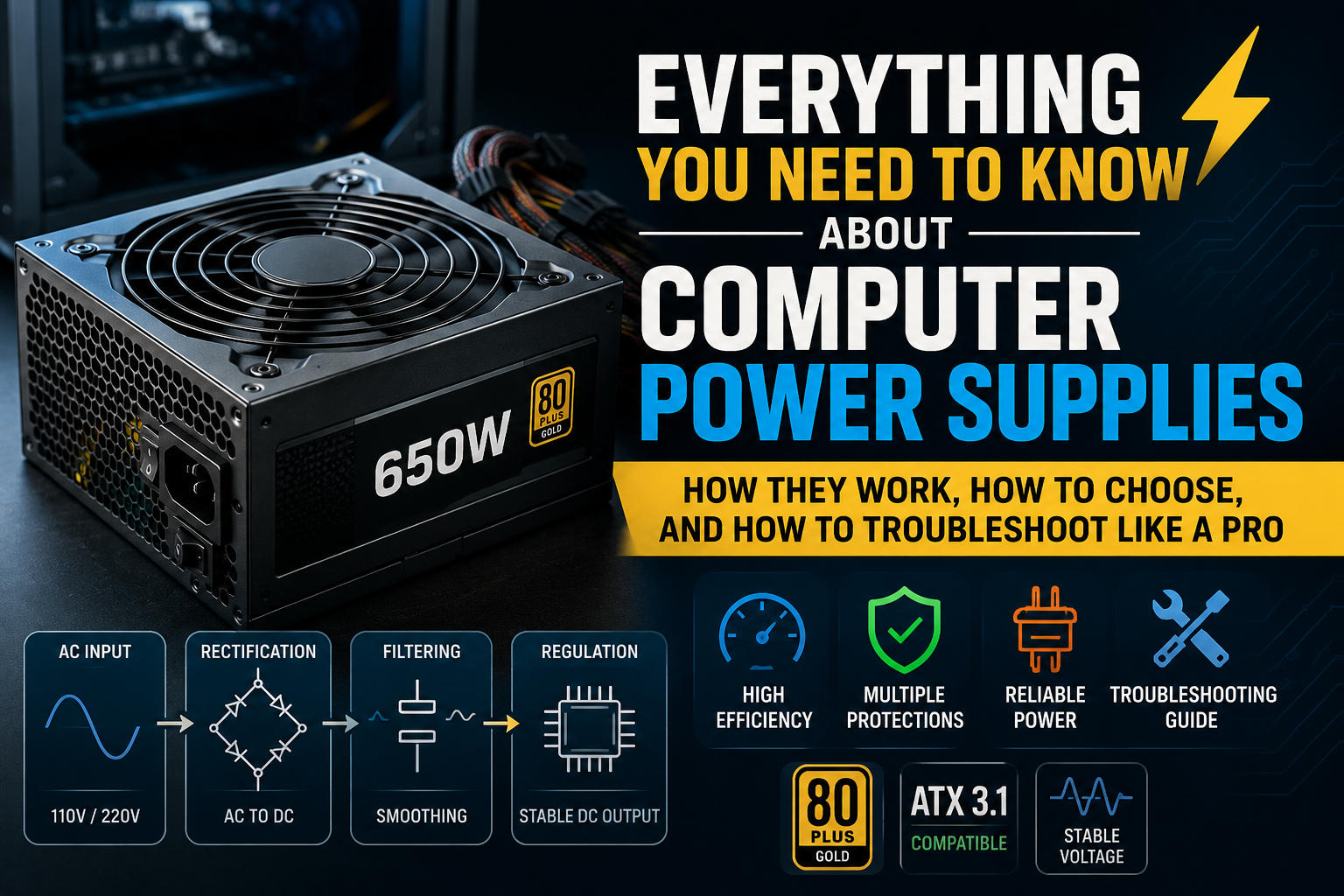
How does a wall outlet delivering high-voltage AC end up safely powering delicate chips inside a PC, phone charger, router, or TV? The answer is the power supply. A power supply does not create energy. Its job is to convert incoming electrical power into the voltage and current a device actually needs, while also filtering noise, regulating the output, and adding protection.
For most modern electronics, that device is a switching mode power supply, usually shortened to SMPS.
What a PSU Actually Does
At a practical level, a power supply has four jobs:
Convert the input power into usable output power.
Keep the output voltage within a safe range as the load changes.
Filter unwanted ripple and electrical noise.
Protect the device during faults such as overloads, short circuits, overheating, or surges.
In desktop computers, the power supply typically converts wall AC into several DC rails such as 12V, 5V, and 3.3V. In phone chargers and many adapters, the output is usually a single low-voltage DC rail, though the exact voltage may vary depending on the charging standard.
AC and DC in Plain Terms
Wall outlets provide alternating current, or AC. In AC, the voltage reverses polarity many times per second, typically 50 Hz or 60 Hz depending on the country. Most electronic circuits need direct current, or DC, where the polarity stays fixed. That means the power supply must convert AC into stable DC before sensitive electronics can use it reliably.
How a Modern SMPS Really Works
One of the biggest misconceptions about power supplies is the order of the internal stages. Older linear supplies often begin with a large mains-frequency transformer that steps the AC voltage down before rectification. A modern off-line SMPS usually does not work that way.
The actual sequence is closer to this:
1. Input Protection and EMI Filtering
The incoming AC first passes through protection and filtering parts. These may include a fuse, a surge suppressor, an inrush current limiter, and an EMI filter made from capacitors and chokes. This stage helps protect the power supply and reduces electrical noise entering or leaving the device.
2. Rectification
Next, a bridge rectifier converts the AC into high-voltage pulsating DC. If the supply is connected to 230V AC mains, the internal DC bus is roughly 325V DC after rectification. On 120V mains, it is much lower, but still dangerous.
3. Bulk Filtering
Large electrolytic capacitors smooth that pulsating DC into a steadier high-voltage DC bus. This is still not the final output used by the device. It is an internal intermediate stage.
4. High-Frequency Switching
Power transistors, usually MOSFETs, rapidly switch that DC on and off at high frequency. A control IC adjusts the switching timing and duty cycle to match the load. This switching stage is the heart of an SMPS and is the main reason switching supplies can be small and efficient.
5. High-Frequency Transformer
The switched waveform is fed into a transformer operating at high frequency rather than at 50 or 60 Hz. This transformer provides isolation from the mains and changes the voltage to the level needed by the output stage. Because the frequency is much higher than line frequency, the transformer can be far smaller than the heavy transformer in a linear supply.
6. Secondary Rectification
On the transformer's output side, the high-frequency AC is rectified back into DC. Depending on the design, this may use fast diodes, Schottky diodes, or synchronous rectification with MOSFETs for better efficiency.
7. Output Filtering
The rectified output still contains ripple, so it is smoothed by capacitors and inductors. Capacitors alone are not the whole story. In many SMPS designs, inductors are equally important for reducing ripple and noise.
8. Feedback Regulation
Finally, a feedback loop monitors the output and continuously adjusts the switching behavior to keep the voltage stable even when the input changes or the load suddenly increases. This control function is usually handled by a PWM or related control circuit. Protection or supervisor circuits may also be present, but they are not the same thing as the main regulation loop.
A Simple Mental Model
If you want the short version, a modern AC-input SMPS usually does this:
Protect and filter the incoming AC.
Rectify it into high-voltage DC.
Switch that DC at high frequency.
Use a small transformer to isolate and change the voltage.
Rectify and filter the output.
Regulate the result with feedback.
That is more accurate than saying a modern SMPS first steps mains AC down with a transformer and then rectifies it.
Linear vs Switching Power Supplies
There are two broad families of regulated power supplies used in electronics.
Linear Power Supplies
A linear supply usually starts with a large 50 or 60 Hz transformer, then rectifies and filters the lower AC voltage, and finally uses linear regulation to maintain the output. Linear supplies can be electrically quiet, but they are bulky, heavy, and less efficient because excess energy is often dissipated as heat.
Common advantages:
Very low output noise
Simpler in some low-power designs
Common disadvantages:
Large and heavy
Lower efficiency
More heat generation
Switching Power Supplies
An SMPS rectifies early, switches at high frequency, uses a much smaller transformer or inductor structure, and regulates with a feedback-controlled switching stage. This makes it far more efficient and compact than a typical linear supply, but it also makes the design more complex and more sensitive to EMI control.
Common advantages:
Higher efficiency
Smaller size
Lower weight
Better fit for modern high-power electronics
Common disadvantages:
More design complexity
More high-frequency electrical noise if filtering is poor
What This Means for a Desktop PC PSU
A desktop ATX power supply is a specific kind of SMPS. It usually provides several DC outputs, with 12V being especially important in modern systems because the CPU and GPU often derive their own lower internal voltages from that rail. Many ATX supplies also provide a 5V standby rail so the motherboard can support soft power control and wake features.
Protection Features That Matter
A good PSU should include protective mechanisms such as:
OVP: Over Voltage Protection
UVP: Under Voltage Protection
OCP: Over Current Protection
OPP: Over Power Protection
OTP: Over Temperature Protection
SCP: Short Circuit Protection
These features do not guarantee perfection, but they reduce the chance that a fault in the power supply or load will escalate into hardware damage.
80 PLUS: Useful, But Limited
An 80 PLUS rating is often treated as a quality stamp, but that is not what it actually measures. 80 PLUS is primarily an efficiency certification. It tells you how efficiently a PSU converts power at defined load levels, and it also includes a power factor requirement for certain categories. It does not directly measure capacitor quality, transient response, ripple suppression, fan profile, long-term reliability, or how well the protection circuits behave.
So a better rule is this: 80 PLUS is helpful, but it is not enough by itself. Efficiency matters, but electrical performance and build quality matter too.
Common PSU Problems and What They Really Suggest
System Completely Dead
Possible causes include no AC input, a bad power cable, a faulty outlet, a failed fuse, a dead PSU, or a separate motherboard power issue. A dead system does not prove the PSU is the only suspect, but it is one of the first places to check.
Random Shutdowns Under Load
This can be caused by inadequate sustained capacity, poor transient handling, overheating, internal aging, or a problem elsewhere in the system. If shutdowns happen only during gaming or rendering, the PSU is a realistic suspect, but not the only one.
Whining or Buzzing
High-pitched coil whine is often annoying rather than dangerous. It may come from the PSU, GPU, or motherboard. By contrast, harsh buzzing, clicking, burnt smell, or instability are more concerning signs and may justify immediate replacement.
Fan Not Spinning
This is not always a failure. Many modern PSUs intentionally keep the fan off at low load or low temperature to reduce noise. Fan behavior should be judged under load and in context, not by idle behavior alone.
Safe Testing Advice
Do not open a mains-powered PSU unless you are trained to work on high-voltage electronics. Large capacitors inside a switched-mode power supply can store dangerous charge even after the unit has been unplugged.
Safer external checks include:
Verifying the outlet and power cable
Testing with a known-good PSU when possible
Measuring output rails with proper equipment if you know the procedure
Using a PSU tester only as a basic screening tool, not as a full health verdict
Software-reported voltages in BIOS or monitoring tools can sometimes hint at problems, but direct measurement under load is more trustworthy.
How to Choose the Right PSU
Choose a PSU based on realistic system needs rather than marketing labels alone.
Good selection criteria include:
Adequate wattage for sustained load
Some headroom for transient spikes and future upgrades
Strong protection features
Good independent reviews
Suitable form factor such as ATX or SFX
Acceptable acoustics and cooling
For many desktop builds, roughly 20% to 30% headroom above realistic maximum sustained demand is a sensible target, though exact needs depend heavily on the CPU and GPU.
Bottom Line
The central idea is simple: a power supply converts incoming electrical power into stable, regulated output power that electronics can use safely. But the internal details matter. In a modern SMPS, the mains AC is typically filtered, rectified into high-voltage DC, switched at high frequency, passed through a compact transformer, rectified again on the secondary side, filtered, and then regulated with feedback.
That sequence is why modern power supplies can be efficient, compact, and capable of powering delicate electronics from dangerous wall voltage. It is also why oversimplified explanations that describe a modern SMPS like an old linear supply are only partly correct.
Read our Computer Power Supply (PSU) Buying Guide
Create a free account to react and start earning credits. Sign up
Be the first to comment (0)
Sign in to comment — you'll come straight back here.